What Is Asset Lifecycle Management?
Published on August 6th, 2025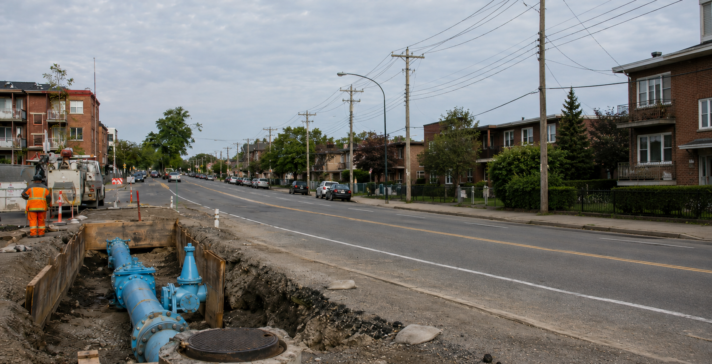
Asset lifecycle management (ALM) is the practice of guiding a physical asset through every stage of its life, from planning and acquisition through operation, renewal, and eventual replacement, so it delivers the most service for the least total cost. The core idea fits in one sentence: what an asset costs is not what you paid for it, but everything it will cost you until the day it retires.
Key takeaways:
- Infrastructure assets pass through five stages: plan and acquire, operate and maintain, monitor and assess, renew or rehabilitate, retire and replace.
- For long-lived infrastructure, the lifecycle is a loop, not a line. A water main may be repaired and relined several times across 75 years before replacement is ever the right call.
- Lifecycle cost is the metric that matters. For infrastructure, the purchase is usually a minority of it.
- Deterioration is not linear. Condition holds, then falls fast, which makes intervention timing the highest-stakes decision in the lifecycle.
- ALM produces the data; Asset Investment Planning turns it into portfolio strategy.
The five stages of the asset lifecycle
- Plan and acquire. The decisions with the longest shadow. Sizing, siting, material, and design choices made before an asset exists will shape its costs for decades. A pipe specified well in 2026 is a renewal deferred in 2066.
- Operate and maintain. The longest stage, and the quietest. Routine and preventive maintenance keep the asset on its intended deterioration path instead of a steeper one.
- Monitor and assess. Inspections, sensors, and condition ratings. You cannot time an intervention on an asset you are not watching.
- Renew or rehabilitate. The stage the equipment world forgets. Infrastructure rarely goes straight from service to scrap. Relining a main, resurfacing a road, or refurbishing a substation buys decades at a fraction of replacement cost.
- Retire and replace. Eventually, renewal stops paying. The asset is decommissioned, and the replacement starts the loop again, ideally smarter than the last time.
Each stage feeds the next, and records from every stage become the evidence base for the ones that follow. That continuity is the whole point: lifecycle management is memory, applied to concrete and steel.
A pipe is not a laptop
Most guides to asset lifecycle management were written for equipment: servers, vehicles, machines you buy, run, and dispose of inside a decade. Infrastructure obeys different physics, and the differences change how the lifecycle should be managed.
| Equipment (IT, fleet, machinery) | Infrastructure (roads, pipes, grids) | |
| Typical service life | 3 to 15 years | 25 to 100+ years |
| End of life | Dispose and repurchase | Renew repeatedly; replace rarely |
| Biggest cost | Often the purchase itself | Decades of operation and renewal |
| Failure consequence | Restore or swap the unit | Service loss for a street, a district, a city |
| The key decision | When to replace | Which intervention, and when |
Two of those differences do most of the work.
Renewal is the main event, not disposal
First, disposal is a footnote for infrastructure; renewal is the main event, and it can repeat for a century. The strategic question is never simply “when do we replace this?” but “which intervention, inspection, preventive treatment, partial rehabilitation, full rehabilitation, extends useful life at the lowest incremental cost, and at what point in the deterioration curve does each option stop paying?” A water main relined at year 40 may deliver another 30 years of service at a fraction of replacement cost. A substation refurbished rather than rebuilt buys decades. Getting that sequence right is what lifecycle strategy actually means, not a schedule, but a decision logic that follows the asset’s actual condition rather than its age on a spreadsheet.

Assets deteriorate in curves; accounting depreciates in straight lines
Accounting depreciates assets in straight lines, but assets deteriorate in curves, and the gap between those two realities has consequences on both the balance sheet and the income statement. When accounting life is shorter than technical life, the asset is fully depreciated on the books while still delivering years of productive service, understating the true value of the infrastructure portfolio on the balance sheet while accelerating depreciation charges that inflate operating costs on the income statement. Conversely, when accounting life exceeds technical life, assets carry residual book value long after their condition has made renewal urgent, masking the true scale of the infrastructure deficit on the balance sheet while understating the depreciation charges that should signal the cost of asset consumption.
Therefore, a capital plan built on book value will intervene at the wrong times and for the wrong reasons. A strategy grounded in condition data aligns financial decisions with engineering reality, catching the renewal window while it is still cheap and reflecting asset consumption honestly across both financial statements.
Lifecycle cost and the timing problem
Every asset traces a condition curve over its life: a long, gentle decline, then a steep drop. Assets fail slowly, then suddenly. Intervene too early and you throw away serviceable life. Intervene too late and the cheap options are gone; what would have been a reline becomes an excavation, and what was maintenance becomes an emergency.
This is why timing, more than any other factor, decides lifecycle cost. Two organizations with identical assets and identical budgets can end up with very different networks, simply because one intervened inside the window and the other missed it. Multiply that window across thousands of assets and you have the central management problem of infrastructure ownership.
Why adopt a lifecycle approach?
Organizations that manage to the lifecycle rather than to the fiscal year see four kinds of return:
- Lower lifetime cost. Planned interventions cost less than emergency ones, and well-timed renewal defers replacement, the most expensive act in the lifecycle.
- Managed risk. Condition data turns unknown failure odds into quantified ones, so risk can be reduced deliberately instead of discovered publicly.
- Operational efficiency. One asset record spanning all stages ends the version of history where finance, engineering, and operations each keep their own.
- The greenest asset is the one you did not have to rebuild. Extending life through renewal cuts material use and embodied carbon, and supports the goals in frameworks like ISO 55000.
The honest challenges
Lifecycle management asks organizations to overcome three stubborn facts. Data lives scattered across departments and formats, and assembling one lifecycle record takes real effort. Budgets are annual while assets are generational, so the process constantly pressures long-term decisions into short-term shapes. And the future refuses to hold still: climate, demand, and costs all move over a 50-year horizon. None of these is a reason to wait. Canada’s Infrastructure Report Card shows what deferring the discipline costs; the deficit compounds either way.
From lifecycle data to investment strategy
ALM tells you the state of each asset and the options open for it. What it cannot do alone is answer the portfolio question: which combination of interventions, across every asset class and every year, fits a fixed budget and keeps service promises intact. That question belongs to Asset Investment Planning, which takes lifecycle data (condition, deterioration curves, intervention menus) and simulates strategies across the whole portfolio.
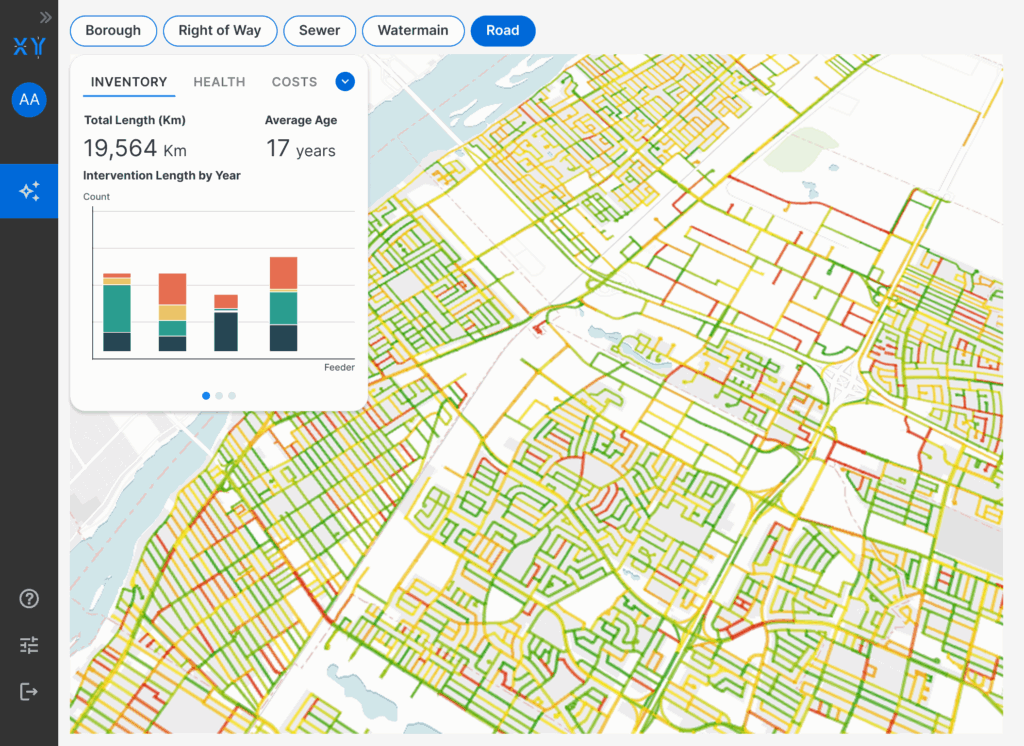
The two disciplines are a pair: lifecycle management without investment planning produces excellent records and underfunded plans, while investment planning without lifecycle data produces confident numbers built on sand. Together they change outcomes, as Montréal’s water network showed when simulation shifted the strategy from replacement toward renewal, and as electric utilities are showing now with grids. For the wider discipline both belong to, see our guide: What is asset management?
The bottom line
Asset lifecycle management is the discipline of the long game: acquire well, maintain deliberately, watch condition, renew at the right moment, and replace only when renewal stops paying. For infrastructure owners, the stakes concentrate in one decision: when to intervene. Get that timing right across a portfolio and the same service costs dramatically less. That timing problem, multiplied by thousands of assets, is exactly where lifecycle management meets investment planning.
Direxyon builds simulation software for the lifecycle’s hardest question: when to intervene, and with what. See how municipalities apply it, or explore the Direxyon Suite.
FAQs
What is asset lifecycle management in simple terms?
It’s caring for a physical asset across its whole life, from the decision to build it to the decision to replace it, so it delivers reliable service at the lowest total cost.
What are the stages of the asset lifecycle?
Five stages: plan and acquire, operate and maintain, monitor and assess, renew or rehabilitate, and retire and replace. For infrastructure, the renewal stage often repeats several times before replacement.
What is lifecycle cost?
Everything an asset costs over its life: design, construction, operation, maintenance, renewal, and disposal, less any residual value. For infrastructure, decades of operation and renewal usually dwarf the original build.
What is the difference between ALM and EAM or CMMS software?
ALM is the practice. EAM and CMMS are software that supports parts of it, mainly tracking assets and managing maintenance work. They record the lifecycle; they don’t plan it.
What is the difference between asset lifecycle management and asset management?
Asset management is the whole discipline, covering strategy, plans, and governance. ALM is the part concerned with each asset’s journey through time, stage by stage.
How does ALM relate to Asset Investment Planning?
ALM manages individual assets through their stages and generates the condition and cost data along the way. AIP works one level up, deciding where capital goes across the entire portfolio. ALM supplies the evidence; AIP turns it into strategy.
How long do infrastructure assets last?
Typical ranges: road surfaces 15 to 25 years between treatments, transformers 30 to 40 years, water mains 50 to 100 or more. The honest answer is that it depends on material, environment, and how well the earlier lifecycle stages were managed.
Does asset lifecycle management apply to IT and fleet assets too?
Yes. The framework is universal; the emphasis shifts. Short-lived assets cycle quickly through acquisition and disposal, while infrastructure lives in the renewal loop, where intervention timing dominates every other decision.
Let us show you how it works
Our product specialists will walk you through our proven approach to enhance your capital investment planning.

Explore resources

 Blog
BlogThe Question Behind Every Infrastructure Budget
Read more : The Question Behind Every Infrastructure BudgetEvery infrastructure budget comes down to one question, asked two ways: what a target level of service costs, and what a fixed budget can achieve.
 Blog
BlogPowering growth without overburdening ratepayers
Read more : Powering growth without overburdening ratepayersConnection requests now arrive in hundreds of megawatts. The hard question is who pays, and how to plan node by node before committing.
- Blog
Reliability and resilience in electrical network planning
Read more : Reliability and resilience in electrical network planningExpected value works for reliability and fails for resilience. A worked example shows how the risk measure you choose, not the investment, decides the capital plan.