What Is Asset Management?
Published on August 9th, 2025
Asset management is the discipline of deciding what to do with physical assets, and when. Roads, water mains, power lines, buildings: each one costs money to keep, degrades on its own schedule, and carries consequences if it fails. Asset management is how an organization weighs those three pressures, cost, risk, and performance, then commits to a course of action it can defend, across the whole life of the asset rather than one budget year at a time.
Key takeaways:
- Every asset decision is a trade among cost, risk, and performance. That trade sits at the centre of the ISO 55000 family of standards.
- Four fundamentals hold the discipline together: value, alignment, leadership, and assurance.
- An asset management plan is the working link between what a community expects and what the budget actually funds. Practitioners call that link line of sight.
- Underneath the frameworks, asset management is a decision problem. A large portfolio generates billions of possible intervention combinations, which is why the field keeps moving toward data and simulation.
- In Canada it is no longer discretionary. Provinces regulate it and federal funding is tied to it.
One term, two meanings
Before going further, one clarification. The phrase also belongs to finance, where firms manage investment portfolios on behalf of clients. That industry is not the subject here. This guide is about physical and infrastructure asset management: the roads, pipes, and networks communities use every day.
Financial asset management | Infrastructure asset management | |
What it manages | Stocks, bonds, investment portfolios | Roads, pipes, power lines, buildings |
Who does it | Banks, wealth managers, fund companies | Municipalities, utilities, public agencies |
The goal | Grow financial returns for clients | Sustain services at the right balance of cost, risk, and performance |
Time horizon | Market cycles | Decades, often the asset’s whole life |
The two fields agree on one premise: assets exist to produce value, and someone has to make deliberate choices about them. Past that, they have little in common.
Why asset management matters
Most North American infrastructure was built in a burst decades ago, which means much of it reaches the end of its service life at roughly the same moment. That convergence lands just as climate pressure, growth, and constrained budgets raise the stakes on every decision. Canada’s Infrastructure Report Card, produced with the Federation of Canadian Municipalities, returns the same finding each cycle: a substantial share of municipal infrastructure sits in fair or poor condition.
Every year renewal is postponed, the cost of catching up grows. That accumulated cost has a name, the deferred maintenance backlog, and it compounds quietly until an asset fails or a regulator asks. Asset management is the alternative to letting it compound. Instead of reacting to failures, organizations set levels of service, which are measurable commitments to the community, then plan interventions to meet those commitments at a cost and risk they have consciously accepted.
Who practices asset management
The organizations doing this work are the ones that own long-lived physical infrastructure and answer to someone for it: municipalities and regional governments, water and wastewater utilities, electric and gas distributors, transportation agencies, and operators of ports, airports, and public building portfolios. What they share is a portfolio too large to manage asset by asset, a service obligation they cannot walk away from, and a budget set by someone else. Asset management is what makes that combination tractable.
The four fundamentals
Canadian practice, shaped by FCM’s Municipal Asset Management Program and by the Institute of Asset Management, rests on four fundamentals.
- Assets are means, not ends. They exist to deliver value to the organization and the people it serves, which makes preserving an asset that no longer serves anyone a cost rather than an achievement.
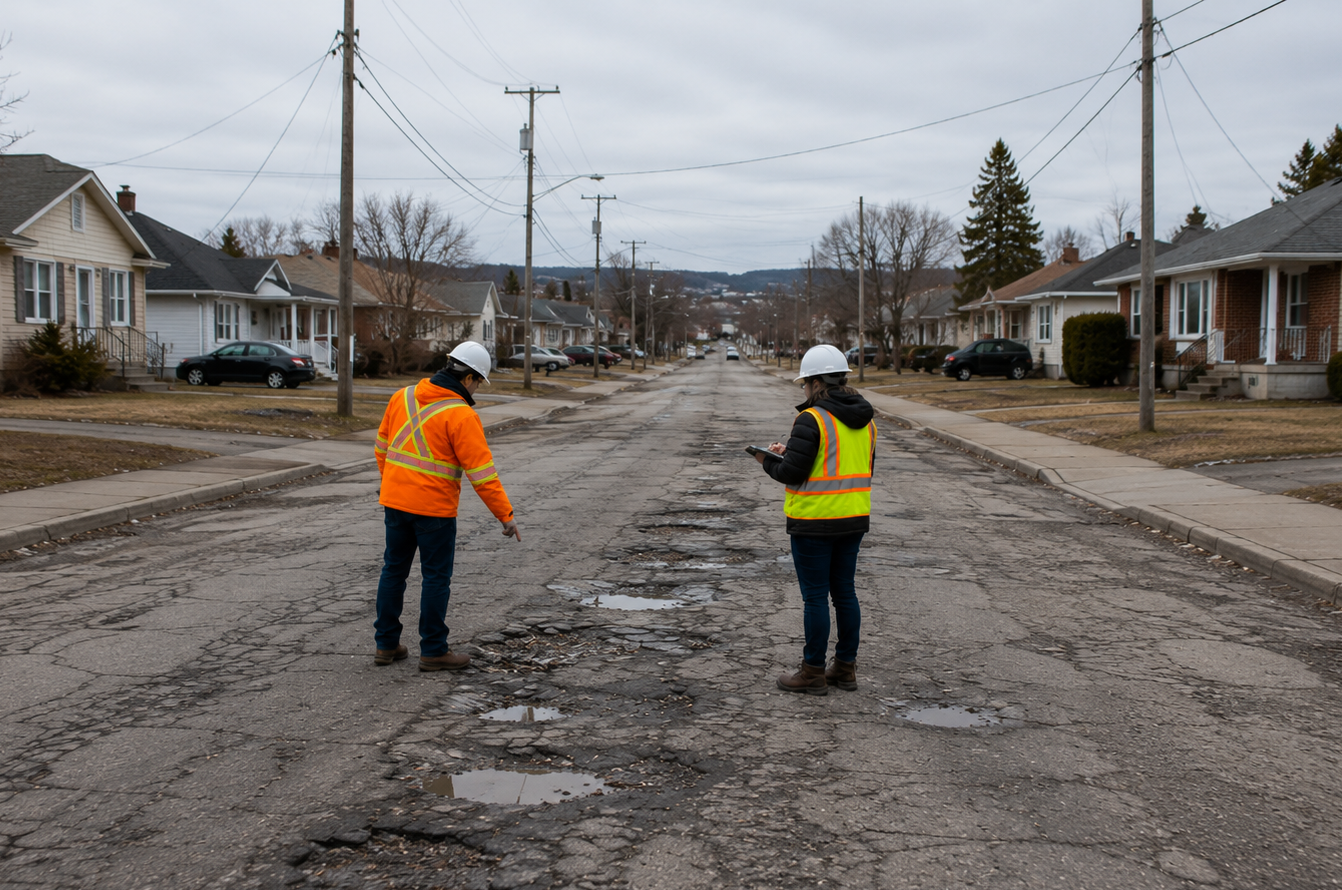
- Asset decisions should be the technical and financial expression of organizational goals. A pothole budget is a policy choice wearing work boots.
- The discipline works when leadership treats it as how the organization runs, not as a document the engineering department produces once a cycle.
- The organization can demonstrate, with evidence, that its assets will do what is required of them.
The core principle: cost, risk, and performance
Every asset decision is a trade. Spend less this year and carry more risk next year. Over-build and other services go without. What good asset management does is put the trade in plain view: it shows what a given budget buys in reduced risk and improved reliability, so councils and boards can choose knowingly instead of hopefully.
The asset lifecycle
Assets pass through four stages: acquire or build, operate, renew or upgrade, and retire. Decisions in one stage set the terms for the others. Underspend on intervention early and assets fail young, which pulls replacement costs forward into a decade that was not planning for them. This is why practitioners plan against the full asset lifecycle rather than the annual budget cycle. The cheapest option this year is frequently the most expensive across thirty.
Asset management is really a decision problem
Here is the part most definitions leave out. Consider a mid-sized city with 3,600 km of water mains. Any segment can be repaired, relined, replaced, or left alone, in this year or in any of the next thirty. Multiply those options across every segment, every road above it, and every plausible budget scenario, and the count of possible plans runs well past the billions.
No committee can evaluate that. Neither can a spreadsheet. Experienced engineers hold remarkable judgment about individual assets, but portfolio-scale trade-offs exceed what human working memory can hold at once. That is the practical reason the discipline keeps moving toward data and simulation. Not fashion, arithmetic.
It is also why asset management and finance keep converging. An intervention strategy behaves like a financial instrument: it has a cost, a return, and a risk profile, and it deserves the analytical rigour a CFO would apply to any other decision of that size. That is the premise Direxyon has built on since 2001, software shaped around how asset managers actually decide rather than around how databases store records.
What is an asset management plan?
An asset management plan (AMP) sets out what an organization owns, the condition it is in, the service it has promised, and what keeping that promise will cost over the long term. In much of Canada it is a legal requirement: Ontario’s O. Reg. 588/17 obliges municipalities to keep one current, and FCM’s program has helped hundreds of communities build the capacity to do so. A good AMP is not a shelf document. It is the working connection between what residents expect and what the budget funds.
ISO 55000 and line of sight
ISO 55000 is the international standard family for asset management. Its central idea is line of sight: every asset decision should trace back to what the organization is trying to achieve, so that every dollar can be explained. The family recently expanded with ISO/TS 55014, which formalizes the requirement for an explicit decision-making framework, including the organizational architecture and the criteria that govern each investment decision. Asset Investment Planning is the analytical machinery that puts both into practice. Implementation is covered in our guide to ISO 55000 best practices.
The maturity path: from inventory to simulation
Few organizations arrive at mature asset management in one move. Most travel the same sequence.
- Know what you own. An inventory: every asset, its age, its replacement cost.
- Know its condition. Inspection and condition data turn a list into a picture of risk.
- Write the plan. An AMP ties condition to service commitments and long-term funding needs.
- Set levels of service. Formal, measurable commitments the community can hold you to.
- Establish the organizational value framework. The Strategic Asset Management Plan (SAMP) converts organizational objectives into explicit decision criteria (risk appetite, target service levels, budget constraints) that will govern every investment decision. Scenarios are then evaluated against it.
- Simulate the future. Test investment strategies across thousands of scenarios before committing funds, scoring each against the SAMP’s value framework to find the combination that best balances cost, risk, and performance. This stage is Asset Investment Planning (AIP).
Most Canadian municipalities sit somewhere around stages two and three. The ones reaching stage five are collecting the return. The City of Montréal used AIP simulation to establish that rehabilitating water mains, rather than replacing them, would still meet its service targets while cutting required annual investment by up to 50%. Electric utilities are walking the same path with networks in place of pipes.
Wherever you are in that sequence, the next stage is reachable. Starting close to zero? Our guide to accelerating asset management in local government covers the first moves. Ready to simulate? See our municipal asset investment planning solutions.
FAQs
What is asset management in simple terms?
It is how organizations decide what to do with their physical assets, and when, so that roads, pipes, power lines, and buildings keep delivering service at a cost and risk the organization can carry across the full lifecycle.
Is asset management the same as wealth management?
No. In finance, asset management means running investment portfolios for clients. Infrastructure asset management, the subject of this guide, is about long-term investment decisions on physical assets so they deliver reliable public services at a sustainable cost.
What are the fundamentals of asset management?
Four: value (assets exist to deliver value), alignment (asset decisions follow from organizational goals), leadership (commitment and culture from the top), and assurance (evidence that assets will perform as required).
What is the difference between asset management and asset investment planning?
Asset management is the whole discipline: policy, data, plans, decisions. Asset Investment Planning (AIP) is the analysis layer inside it, simulating investment scenarios across the portfolio to find the best long-run balance of cost, risk, and service.
What is an asset management plan?
A strategic document recording what an organization owns, its condition, the service levels it targets, its lifecycle strategies, and its long-term funding needs. Several Canadian provinces, Ontario among them, require municipalities to maintain one.
What is ISO 55000?
The international standard family for asset management. It sets out the requirements for an asset management system and centres on one principle: line of sight between organizational objectives and asset decisions.
Why is asset management important for municipalities?
Because infrastructure is aging faster than budgets are growing. It lets municipalities hold their service commitments at a cost taxpayers can carry, satisfy provincial and federal requirements, and justify spending with evidence rather than instinct.
What does an infrastructure asset manager do?
Keeps a portfolio of physical assets delivering its promised service at a cost and risk the organization can accept. The role spans inventory and condition data, lifecycle and renewal planning, risk assessment, capital budget recommendations, and reporting to leadership, councils, or regulators.
Do you need perfect data to start asset management?
No. Most organizations begin with partial inventories and thin condition data. Start making structured decisions with what you have and improve the data as you go.
The bottom line
Asset management is how organizations keep their infrastructure promises, balancing cost, risk, and performance across the full lifecycle of roads, pipes, power lines, and buildings. It stands on four fundamentals, it is codified in ISO 55000, and in Canada it is increasingly written into law. Strip the frameworks away and one thing remains: a decision problem at a scale no committee or spreadsheet can hold. The organizations pulling ahead, Montréal among them, are the ones giving those decisions the rigour they warrant.
Direxyon has built asset investment planning software since 2001, around three capabilities that work together: lifecycle strategy simulation that encodes how your organization manages each asset family and produces probabilistic budget envelopes; a value-based multicriteria framework that allows investments across entirely different asset categories to be compared on a common, risk-adjusted basis; and Monte Carlo simulation that models uncertainty explicitly, so every plan comes with confidence intervals rather than false precision. Made for the people who must turn condition data, budgets, and community expectations into defensible decisions. To see these principles in action, explore our Asset Investment Planning solutions.
Let us show you how it works
Our product specialists will walk you through our proven approach to enhance your capital investment planning.

Explore resources

 Blog
BlogThe Question Behind Every Infrastructure Budget
Read more : The Question Behind Every Infrastructure BudgetEvery infrastructure budget comes down to one question, asked two ways: what a target level of service costs, and what a fixed budget can achieve.
 Blog
BlogPowering growth without overburdening ratepayers
Read more : Powering growth without overburdening ratepayersConnection requests now arrive in hundreds of megawatts. The hard question is who pays, and how to plan node by node before committing.
- Blog
Reliability and resilience in electrical network planning
Read more : Reliability and resilience in electrical network planningExpected value works for reliability and fails for resilience. A worked example shows how the risk measure you choose, not the investment, decides the capital plan.