Infrastructure Investment Planning: From Needs to Priorities
Published on November 18th, 2026
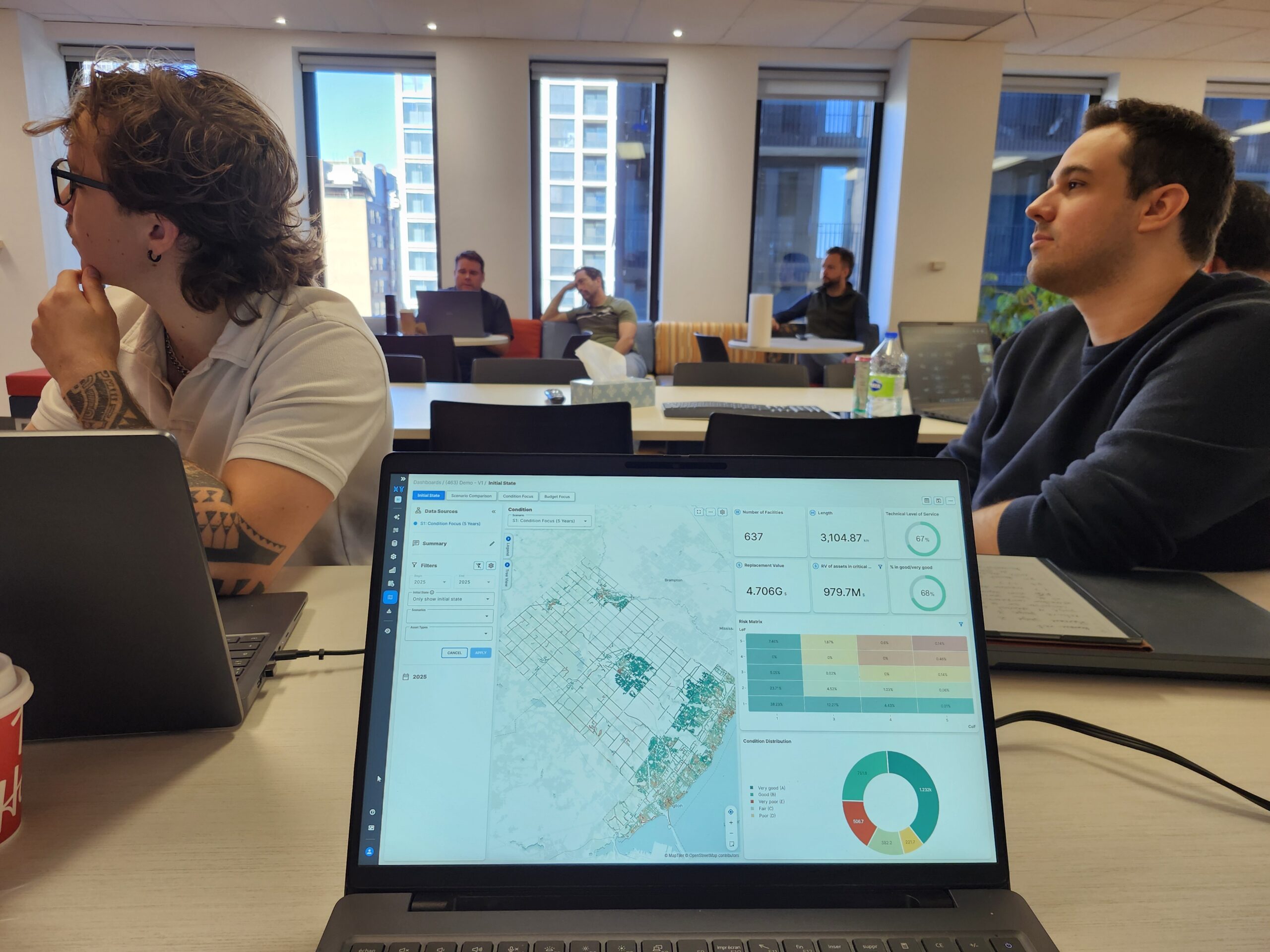
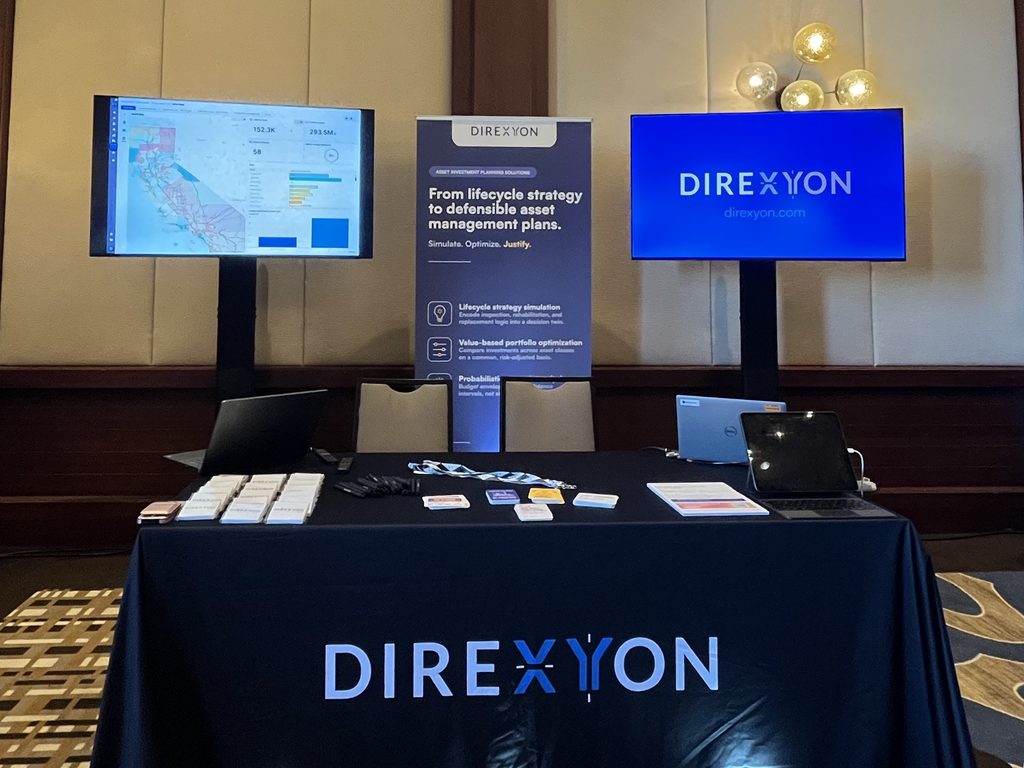
The Direxyon team attended the IAM North American Conference in Toronto in October 2026. The Institute of Asset Management (IAM) is a not-for-profit professional body that works to advance the asset management discipline. Its North American conference brings together infrastructure asset management professionals from across the continent for practical workshops, presentations and the IAM North America Awards. Bernard Gaudreault, Direxyon’s President, sits on the IAM Board of Management. For our team, the conference is a chance to hear how organizations put asset management into practice.
Across the 13 sessions we followed, one theme came up more than any other: organizations want to demonstrate where the next dollar creates the most value. Municipalities, transit agencies and utilities shared how this shapes their approach to infrastructure investment planning. It is less a list of projects and more a set of trade-offs they must be able to explain. Five ideas stood out.

Infrastructure investment planning starts with value and affordability
The value framework gives technical teams, finance and leadership one language. It lets an organization compare a road project, a pump replacement and a building renewal on the same basis. DelDOT, Delaware’s transportation department, turns ten-year forecasts into funding and performance curves. The slope of each curve shows where the next dollar does the most good.
Affordability comes first, though. An informal survey of Ontario municipalities, shared by the Town of Newmarket, ranked it ahead of levels of service and risk when setting the 2025 targets required under Ontario Regulation 588/17. In the town’s road example, ten-year funding needs climb from about $13 million to $54 million as the pavement condition target rises from 58 to 65. When the budget is fixed, the risk isn’t, and each funding level needs a clear explanation.
Compare lifecycle strategies, not only projects
Replacement is not always the answer. Toronto Hydro showed that maintenance improves the apparent condition of obsolete circuit breakers. It does not, however, remove the ongoing costs or the shortage of parts behind them.
Renewable Water Resources (ReWa), in South Carolina, combines inspections and thermography to extend the life of critical equipment. The speaker reported $12 million in capital spending deferred over two years, with the full economic analysis still under way.
Deferral frees capital today. Its real benefit depends on future maintenance, failure risk and supply lead times. Comparing repair, monitoring, rehabilitation and replacement over time turns deferral into an informed choice. Our guide to asset lifecycle management explores these lifecycle strategies in more detail.
Risk means more than failure
The updated IAM guidance on risk defines risk, in line with ISO 31000, as the effect of uncertainty on objectives. That effect can be positive or negative, and it touches service, capacity and resilience.
Yet many organizations still multiply scores from 1 to 5 risk matrices. This ranks assets, but it does not measure expected loss. Closing that gap starts with expressing consequences in common units, such as dollars or value points, and modelling the likelihood of failure over time. Monte Carlo simulation then propagates the uncertainty. It shows the full range of possible outcomes, so planners can compare strategies under the same budget and see how risk evolves over time.
Data quality belongs in the decision
WSSC Water, in Maryland, found that more than 65% of the data in a sewer rehabilitation pilot was unstructured. Reports could lag by up to three months. The City of Columbus, for its part, is adding a data quality grade to its AIMS asset management platform and naming clear data owners.
Neither waited for perfect data. The practical step is to label what is observed, estimated or assumed, then test which data actually change the decision. A value filled in by AI should never look like a field measurement. A clear asset health index, paired with a confidence grade for each input, helps teams see where better information matters most.
AI supports decisions, people own them
A session on AI governance drew a clear line. An AI recommendation is not a commitment of resources. The person who approves it needs the skills, information and authority to challenge it.
A crowd-sourced playbook built at the conference confirmed this caution. Most practitioners still use AI for drafting, notes and research, while capital planning appears among the next opportunities. Recording the data, rules, assumptions and model version behind each choice keeps AI-assisted decisions open to review. Our use case on transparent decision-making shows how this works in practice.
How Direxyon supports infrastructure investment planning
Many organizations at IAM already have solid tools, from Richmond Hill’s decision support system to DelDOT’s specialized models. Better data and software help, but they are not enough on their own. The real test is answering the questions council, finance and residents ask before funds are committed.
Direxyon Enterprise was built for exactly that, drawing on 25 years of asset investment planning expertise. It helps your team answer:
- “What do we get for this budget?” You enter your budget options. Direxyon simulates how your assets will age under each one and shows the condition, service level and risk to expect, year by year.
- “Why this project and not that one?” You set your priorities and how much each one counts. Direxyon scores every project the same way and finds the mix that delivers the most value within your budget.
- “Can we safely defer?” For each asset, Direxyon compares options such as repair, rehabilitation or replacement, and the best time to do them. You see the cost and risk of waiting before you decide.
- “How sure are we?” Direxyon runs many possible futures using Monte Carlo simulation. You see the most likely result and the chance of missing your targets.
- “Is our data good enough?” You can start with incomplete data. AI fills in missing values, flagged so they are never mistaken for field data, and the model gets better as your data improves.
- “What if the budget changes?” Change the amount and run the scenario again. Your project list updates, with no spreadsheets to rebuild.
Conferences like IAM remain a key meeting place for asset managers to compare approaches, test ideas and learn from results achieved elsewhere. Direxyon will keep taking part, as attendees and through Bernard’s work on the IAM Board of Management, because these exchanges sharpen the questions our software is built to answer: what each budget delivers, which projects come first and what it costs to wait.
If your organization is working through the same trade-offs, bring one budget question to a personalized demo, and we’ll answer it using assets like yours. For the utility perspective, read our takeaways from CEATI 2026.
Frequently Asked Questions
Define each value criterion so that the same impact is counted only once. Where asset criticality represents failure consequences already captured in the risk assessment, it should not receive an additional standalone weighting. Evaluate each intervention by the change in risk it delivers relative to a realistic baseline over a common planning horizon. Capture other benefits—such as service improvements, additional capacity and lifecycle cost savings—separately, ensuring they do not overlap with impacts already included in the risk calculation.
It works well for screening and communication. However, its scores are ordinal, so multiplying them does not give an expected loss. To allocate funds, convert likelihood and consequence into values you can add up, such as dollars or value points, ideally with uncertainty ranges.
Deferral does not avoid replacement; it shifts it in time. It makes sense when the added cost of each year of waiting stays below the value of postponing the investment, roughly the replacement cost multiplied by the discount rate. The cost of waiting includes added maintenance, monitoring, expected failure costs and the risk created by supply lead times. It also needs clear triggers, such as inspection thresholds, that tell you when to act.
Keep the specialized models, but agree on common outputs: the same horizon, discount rate, risk units and value criteria. Their results can then be compared in one portfolio. Funding and performance curves only compare well when each program’s performance measure means the same thing in value terms.
Flag every imputed value so it is never mistaken for a field measurement, and record how it was produced. Then test whether the decision changes when those values change. Field verification should start where imputed data affects the ranking of projects. In Direxyon, imputed values are flagged so teams always know what comes from real data.
Let us show you how it works
Our product specialists will walk you through our proven approach to enhance your capital investment planning.

Explore resources

 Blog
Utility Capital Planning: Seven Insights from Industry Leaders
Read more : Utility Capital Planning: Seven Insights from Industry LeadersSeven insights from CEATI 2026 on how utilities build, defend and update their capital plans.
 Blog
Asset Investment Planning: From Asset Data to Decisions
Read more : Asset Investment Planning: From Asset Data to DecisionsAn asset investment planning model links every asset, its condition, its risk, and its costs, so every figure in your capital plan can be traced and defended.
 Blog
The Question Behind Every Infrastructure Budget
Read more : The Question Behind Every Infrastructure BudgetEvery infrastructure budget comes down to one question, asked two ways: what a target level of service costs, and what a fixed budget can achieve.